Michigan
What is Tri-Share child care program and is it working in Michigan?


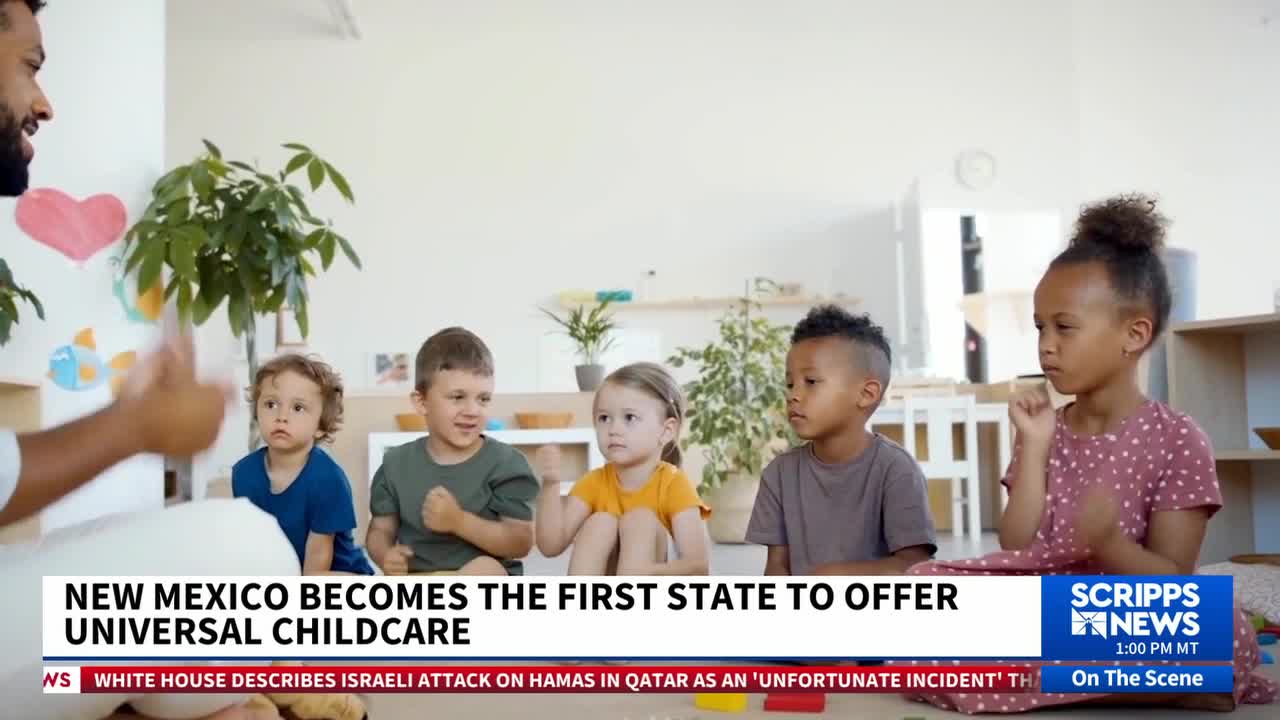

New Mexico turns into the primary state to supply free youngster care to each household
New Mexico will grow to be the primary state within the nation to ensure free youngster look after all households, no matter earnings, when this system launches on November 1.
Scripps Information
- Two members of the Michigan Home wish to take a look at a nationwide program to pay for youngster care in a nationwide pilot.
- This system, referred to as Tri-Share in Michigan, splits youngster care prices among the many worker, employer and state authorities.
The federal authorities is following Michigan’s lead.
Members of the U.S. Home of Representatives from Michigan from each side of the aisle launched a invoice to pilot a toddler care cost-sharing program referred to as Tri-Share. This program began in Michigan and has saved households greater than $11 million in 4 years.
This system goals to cut back the burden on households and enhance affordability by dividing the prices of childcare equally between the worker, their employer and the federal government. Via Tri-Share, firms can select to supply this system as a profit to income-eligible staff.
U.S. Rep. John James, R-Shelby Township, and Rep. Hillary Scholten, D-Grand Rapids, announced new laws on December 15. $250 million can be allotted to check this system throughout the nation.
The invoice comes at a time when childcare prices are excessive increasingly difficult for families to affordand is It is often cited in studies as one of the most expensive monthly household expenses for households, along with issues comparable to lease and transport.
Tri-Share is constructed on the elemental thought that companies are influenced by the supply and accessibility of kid care. If an worker can not discover secure, constant youngster care, they might miss work or have to depart their job altogether, which is expensive for each the worker and the employer. Underneath the laws, states would have the ability to apply for federal {dollars} to develop current Tri-Share packages or begin new ones.
Information of the federal pilot obtained combined reactions from youngster care advocates. Some expressed delight {that a} state program might grow to be a mannequin for the nation, whereas others mentioned price sharing solely addresses one problem in youngster care, and that laws ought to do extra.
What would the federal pilot program seem like?
The federal program is designed as a pilot, as Tri-Share remains to be a comparatively new mannequin, and the FBI desires to start out small with a concentrate on knowledge assortment to see how efficient Tri-Share is in growing entry to youngster look after households.
Underneath the federal pilot, all states, each people who have established Tri-Share packages and people that don’t, can apply for as much as $20 million over the three-year program. The program would provide federal matching dollars to further assist state fundsjust like Medicaid’s cost-sharing construction.
The hope is that the $250 million pilot might fund between 25 and 40 states to develop or create new Tri-Share packages.
The federal pilot program’s earnings threshold is 500% of the federal poverty stage, which is above eligibility necessities in most Tri-Share states. To qualify for Tri-Share in Michigan, household earnings have to be between 200% and 400% of the federal poverty stage. currently about $32,000 for a household of four.
The pilot’s promise of federal {dollars} might incentivize state packages to boost their earnings thresholds, making Tri-Share accessible to extra households.
The pilot might additionally assist get extra nationwide employers on board to supply Tri-Share to staff, mentioned Shannon Garrett, senior Tri-Share program advisor at MiLEAP, the state early childhood schooling company that oversees this system.
Garrett mentioned she has heard from a lot of employers working in Michigan and a number of other different states who’re however can not at present provide Tri-Share as a company-wide profit as a result of it isn’t out there in each state the place they’ve a presence.
Does Tri-Share work in Michigan?
Tri-Share began as a workforce improvement initiative in response to how employers might recruit and retain expertise, Garrett mentioned, and was piloted in three Michigan counties. Not a pilot undertaking, the state is now investing $3.4 million in this system, which is out there as a profit to all companies within the state.
In response to one 2024 Evaluation of Michigan Tri-ShareThis system was anticipated to serve roughly 2,000 youngsters and roughly 1,600 households statewide by 2025. However in accordance with MiLEAP knowledge, this system at present serves 1,000 youngsters and 900 households.
Garrett mentioned the truth falls in need of the goal as a result of Tri-Share’s unique objectives have been formidable and this system remains to be new and solely began seeing important momentum in including employers and households to this system in 2023, after it was now not a pilot program — which made many employers much less prone to take part — and there was extra state funding.
Presently, this system is at about capability for fiscal 12 months 2025, however there will probably be room to develop with transferred funds in 2026, she mentioned.
To encourage extra employers to enroll, the state has made a number of adjustments to this system, together with increasing earnings eligibility to 400% so extra employees can qualify and creating Care-Sharea not too long ago launched Tri-Share add-on that permits employers to supply the profit to all staff, no matter earnings eligibility. For Care-Share, the state doesn’t contribute, so employers pay one-third and staff two-thirds of the prices of childcare.
Of the almost 300 Tri-Share employers in Michigan, greater than half have been micro or small companies, in accordance with the 2024 evaluation. Many of those are youngster care suppliers themselves, which is an unintentional blissful coincidence of this system, says Annette Sobocinski, govt director of Little one Care Community, an early childhood nonprofit in southeast Michigan.
“I see it as an enormous benefit,” she says. “It simply means more cash is being invested within the early childhood system, and what’s dangerous about that?”
The following step is to ramp up the marketing campaign to teach extra employers throughout the state about Tri-Share to get a extra numerous group of firms to take part, particularly mid- to large-sized firms throughout industries, mentioned Wealthy Van Tol, who works in early childhood schooling at Bay-Arenac ISD. Van Tol’s area was certainly one of three in Michigan the place Tri-Share was first examined.
The state ought to concentrate on making connections with main commerce associations — such because the Michigan Well being and Hospital Affiliation or the Michigan Producers Affiliation, he mentioned.
“We have to get these massive teams on the state stage to start out pushing [Tri-Share] “We’re not fairly over that hurdle but… we have to do our greatest to get the phrase out that we’ve success tales on the native and regional stage.”
Supporters of the Tri-Share mannequin say they’re proud that different states, and now the federal authorities, wish to Michigan for innovation in youngster care coverage.
“It is actually thrilling to see what we’re doing right here in Michigan replicated throughout the nation,” Garrett mentioned.
Whereas Sobocinski mentioned Tri-Share just isn’t a silver bullet, she considers Michigan’s program a hit as a result of she has seen it assist households firsthand.
“It has made a distinction of their lives and of their monetary well-being,” she mentioned.
Early Childhood Consultants critical of the mannequin acknowledges that whereas it’s helpful in serving to enterprise leaders see youngster care as one thing that impacts their staff and their backside line, it’s finally an answer designed to fill one hole – affordability – in a damaged youngster care market with many extra gaps, together with a scarcity of accessible seating, excessive trainer turnover, and an unsustainable enterprise mannequin, all of which stem from a scarcity of public funding.
“The whole lot we’ve performed is an answer,” Van Tol mentioned. “Tri-Share, Care-Share, Employers Creating Partnerships and Vouchers.”
What is required are federal and state funds of the sort which are invested in different sectors already accepted as public items, comparable to our Ok-12 schooling system, Van Tol mentioned.
Consultants additionally level to the pandemic-era momentary aid funds because the form of funding the kid care sector wants in the long run to operate correctly and emerge from the disaster.
Beki San Martin is a fellow on the Detroit Free Press masking youngster care, early childhood schooling and different points impacting the lives of youngsters 5 and underneath and their households in metro Detroit and throughout Michigan. Contact her at rsanmartin@freepress.com.
This fellowship is supported by the Bainum Household Basis. The Free Press retains editorial management over this work.






Eileen Gu claims to have been ‘physically assaulted’ since representing China

Michigan winter storm continues Wednesday. Search snow totals by address

Shia LaBeouf breaks silence after Mardi Gras arrest

I-696 and I-75 interchange ramps closing in March for construction

The East Bay’s tastiest, most tantalizing SF Beer Week events

AOC’s clean-up attempt in New York Times interview mocked by critics

8 Skiers Found Dead, 1 Missing in Lake Tahoe Avalanche

West Bloomfield man sentenced to federal prison for unemployment insurance fraud; also to pay hefty restitution

US District Judge rules that President Trump can dismantle USAID

Who’s running for Michigan’s 10th Congressional District?

When is Holland’s tulip festival? What to know about the west Michigan event

WATCH LIVE: Stranded NASA astronauts heading back to Earth in SpaceX capsule

President Trump’s Address to Congress – Key Takeaway

5 common Michigan snakes you may see as the weather warms

Michigan hunter? Here’s a list of the hunting seasons for 2025

La Loulou brings a slice of Paris to Piedmont Ave., Cafe Noir moves to Prescott Market
-
 Michigan12 months ago
US District Judge rules that President Trump can dismantle USAID
-
 Macomb County10 months ago
Who’s running for Michigan’s 10th Congressional District?
-
 Michigan10 months ago
When is Holland’s tulip festival? What to know about the west Michigan event
-
 National News11 months ago
WATCH LIVE: Stranded NASA astronauts heading back to Earth in SpaceX capsule
-
 Michigan12 months ago
President Trump’s Address to Congress – Key Takeaway
-
 Michigan10 months ago
5 common Michigan snakes you may see as the weather warms
-
 Michigan10 months ago
Michigan hunter? Here’s a list of the hunting seasons for 2025
-
 Oakland County9 months ago
La Loulou brings a slice of Paris to Piedmont Ave., Cafe Noir moves to Prescott Market